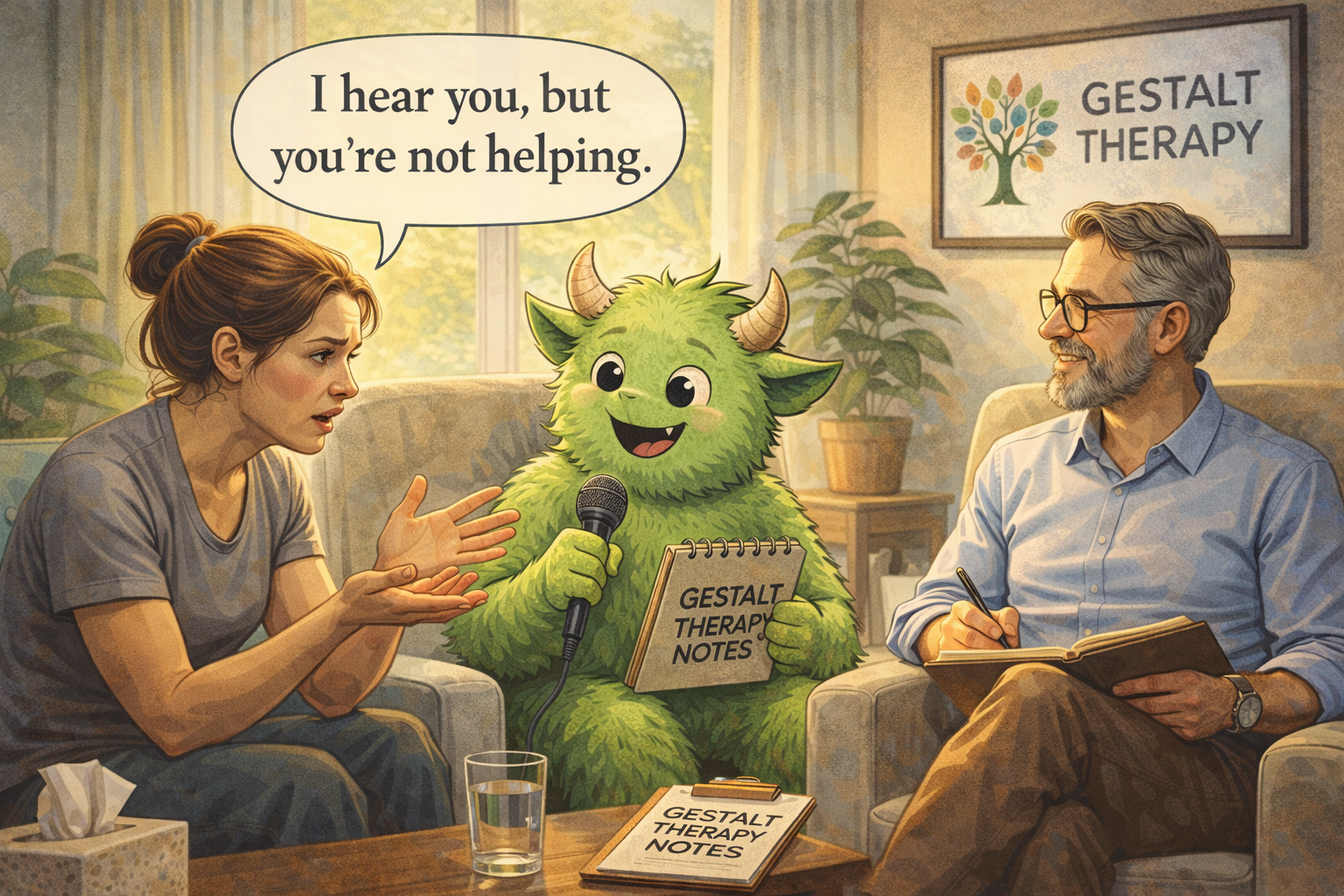

The inner critic is a familiar presence for many people, that internal voice that can judge, shame, create self-doubt, and of course often demands nothing less than perfection of us. In psychotherapy, this voice is often linked to anxiety, depression, low self-worth, and chronic self-sabotage.
Gestalt therapy offers a distinctive and experiential approach to working with the inner critic, not by silencing it or “fixing” it, but by bringing it into awareness, dialogue, and integration.
Understanding the Inner Critic in Gestalt Therapy
Gestalt therapy, founded by Fritz Perls, is rooted in the belief that psychological distress can arise from disowned or fragmented parts of the self. Rather than viewing the inner critic as an enemy or a cognitive distortion, Gestalt therapy understands it as a part of the person, one that developed for a reason, often as an adaptive response to early relational or environmental conditions.
From a Gestalt perspective, the inner critic commonly represents internalized authority figures: parents, teachers, cultural norms, or social expectations. These voices become absorbed so that it feels like part of us and continues to operate long after their original context has passed.
The problem is not that the critic exists, but that it operates automatically, rigidly, and outside conscious awareness.
Awareness as the Core Intervention
Awareness is central to Gestalt therapy. When working with the inner critic, the first step is helping the client notice when the critic appears, what it says, and how it affects the body and emotions. Instead of analysing the critic intellectually, Gestalt therapy emphasizes the present moment experience.
You may be guided to observe questions such as:
- What is the tone of the inner critic’s voice?
- Where do you feel it in your body?
- What happens to your posture, breathing, or energy when it speaks?
By bringing the inner critic into awareness, you shift from being unconsciously controlled by it to being in relationship with it, one that starts to enable positive change.
The Use of Dialogue and the Empty Chair
One of the most well-known Gestalt techniques for working with the inner critic is the empty chair exercise. In this approach, the inner critic is externalized and given a voice of its own. The client may sit in one chair as themselves, and in another chair as the inner critic, speaking its messages out loud. If you are self-conscious, don’t worry we can work through this without physically moving chairs!
This technique serves several purposes:
- It makes the critic concrete rather than abstract
- It reveals the critic’s intentions, fears, and demands
- It exposes the emotional impact of the critic on the self
When spoken aloud, the critics tendency to have extremes in thinking become clearer. You may also discover that the critic believes it is protecting you, trying to prevent failure, rejection, or shame. This reframing allows compassion to emerge.
Polarities and Inner Conflict
Gestalt therapy frequently works with polarities—opposing parts within the self. The inner critic is often paired with a vulnerable, spontaneous, or creative part that has been suppressed. For example, the critic may demand control and perfection, while the other side longs for rest, play, or authenticity.
Rather than choosing one side over the other, Gestalt therapy aims for integration. Through experiential work, clients are encouraged to embody both poles and explore their needs. This process often reveals that the critic dominates because the vulnerable side has not been given adequate voice or support.
Integration Rather Than Elimination
Unlike approaches that aim to silence or eliminate the inner critic, Gestalt therapy seeks integration. The goal is not to destroy the critic, but to soften it, and place it in proper relationship with the rest of the self. When integrated, the critic may transform into a helpful guide, rather than a tyrant!
Through awareness, dialogue, and embodied experimentation, Gestalt therapy helps you to move from internal battles to a new sense of cooperation. The inner critic, once a source of distress, can become an opportunity for self-understanding, growth, and self-support.
Gestalt therapy does not ask, “How do I get rid of my inner critic?” but rather, “What is this part asking for, what does it need and how can I respond with awareness and compassion”
Self-Help Tips for Working with the Inner Critic
While Gestalt therapy is traditionally practiced in a therapeutic relationship, you can begin reflecting on your inner critic.
- Notice the Critic in the Present Moment
Instead of arguing with the inner critic, begin by noticing it. When a critical thought arises, pause and name it: “My inner critic is speaking right now.”Pay attention to what is happening in your body, e.g. tightness in the chest, shallow breathing. This simple act of awareness can reduce the critic’s automatic power. - Externalize the Voice
Try writing down exactly what the inner critic says, word for word. Avoid softening or censoring it. Seeing the critic on paper helps separate youfrom the voice and reveals how extreme or repetitive it may be. Ask yourself: Whose voice does this sound like? When did I first hear this message? - Strengthen the Disowned Part
Notice what part of you the critic suppresses creativity, rest, vulnerability, pleasure, or spontaneity.
If you would like to work with me on your inner critic, please do get in touch
text and WhatsApp 07778 635 050